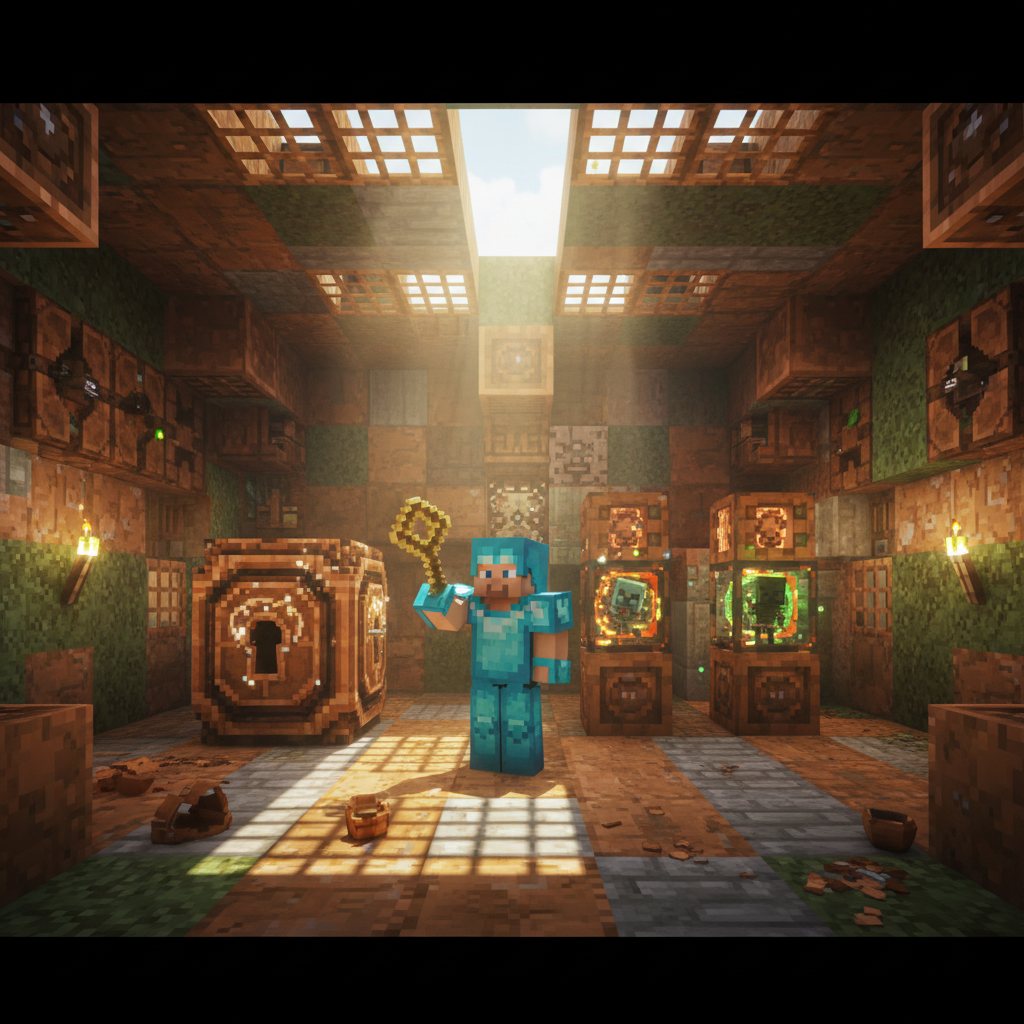
Trial Keys, Ominous Trials and Vault Loot (1.21+)
Intro (Java & Bedrock 1.21+)
Trial Chambers in Minecraft 1.21 introduced a new style of structured combat: enclosed rooms with trial spawners, escalating waves, and vaults that you open with special keys. The system is designed to reward careful, repeatable dungeon runs instead of one-and-done chest looting. This guide explains what Trial Keys and Ominous Trial Keys are, how Ominous Trials work, how vault loot works (including what affects it and what does not), and how to run Trial Chambers efficiently on both Java Edition and Bedrock Edition in 1.21+.
This is a mechanics-focused guide rather than a seed/coordinates guide. Trial Chambers generate underground; your exact layout will vary, but the rules for spawners, keys, and vaults remain consistent across worlds and largely consistent across editions (with some differences called out explicitly).
What you get (Rewards and outcomes)
By learning Trial Keys, Ominous Trials, and vaults, you can reliably farm high-value items in a repeatable way without needing villager trading or large farms. Here’s what you get from mastering this content:
1) Reliable access to vault loot. Vaults are special containers in Trial Chambers that require a key. They provide a one-time reward per player per vault (important for multiplayer), rather than being endlessly farmable like some old chest structures. You’ll be able to clear a chamber, open multiple vaults, and leave with a meaningful set of items.
2) Two tiers of loot: normal and ominous. Normal Trial Keys open normal vaults. Ominous Trial Keys open ominous vaults. Ominous content is meant to be harder and more rewarding.
3) Combat practice and sustainable resources. Trial Chambers are combat-heavy and provide drops from mobs you fight, plus additional structure-specific rewards via vaults. Even when you are not chasing rare items, chambers are good for stocking basics (food, arrows, blocks, and gear replacements) through normal gameplay loot sources.
4) Repeatable progression. Trial spawners don’t behave like classic mob spawners; they are designed for “run this room” gameplay. You can clear many rooms in a single chamber run, then move on to another chamber.
5) Multiplayer-friendly rewards. Vaults are designed so each player can receive rewards from the same vault, rather than one player taking everything. This makes them great for co-op dungeon runs.
Requirements & version notes (Java vs Bedrock)
Minimum version: Minecraft 1.21+ (both Java Edition and Bedrock Edition). Trial Chambers, trial spawners, Trial Keys, Ominous Trials, and vaults are 1.21-era features. If you’re playing on a server, make sure the server version (and any proxy) is updated; client-only updates are not enough.
World compatibility: Existing worlds can generate Trial Chambers only in newly generated chunks (areas you have never explored before). If you updated an old world and you don’t see Trial Chambers near your base, travel to new terrain.
Java vs Bedrock behavior differences:
General parity: The core concepts—Trial Keys dropping from trial encounters, Ominous Trials existing as a harder variant, and vaults requiring keys—are intended to be similar across editions in 1.21+. In typical gameplay, the loop “fight in chamber → get keys → open vaults” works on both.
Exact loot tables and some timing details may differ: Mojang often keeps overall rewards consistent while allowing some edition-specific differences in loot table weights, UI messaging, and edge-case behavior (especially around multiplayer and chunk loading). If you are optimizing for a specific item, verify in your edition by testing multiple runs.
Performance and simulation distance differences: Bedrock’s simulation distance and entity handling can make long fights feel different, especially on lower-end devices. Java has different entity cramming and despawn nuances. These differences can affect how safe it is to kite mobs or how far you can run without resetting the encounter.
If something seems inconsistent: Treat the in-game behavior as authoritative for your edition and version. Minor changes can occur in patch updates (1.21.x). If you notice your chamber not behaving as described here, check your patch version and official patch notes.
Difficulty setting matters: While you can enter Trial Chambers on any difficulty, the combat experience, mob survivability, and your margin for error strongly depend on difficulty. For your first run, Normal is a reasonable balance; Hard significantly increases danger.
Materials (Recommended gear and supplies)
Trial Chambers are compact, wave-based fights with limited safe exits. Bring supplies that help you survive burst damage, manage crowds, and keep visibility high. These are recommendations, not strict requirements.
Armor: Diamond or Netherite armor is strongly recommended. Enchantments like Protection, Blast Protection (situational), Feather Falling, and Unbreaking help a lot.
Weapons: A strong melee weapon (sword or axe) and a ranged option (bow/crossbow). Bring plenty of arrows or use Infinity (Java) / large arrow stacks (Bedrock).
Shield: Very helpful for survivability (especially against projectile pressure), particularly on Java where shields are a core defensive tool.
Food: High-saturation food (cooked porkchops, steak, golden carrots). Golden apples are excellent for emergencies.
Potions (optional but powerful): Healing, Regeneration, Strength, and Fire Resistance (situational). Night Vision helps in darker corners.
Blocks: A stack of solid blocks for emergency cover, bridging, or making a safe corner. Also bring a few slabs or trapdoors if you like controlling pathing (use carefully; don’t trap yourself).
Torches / light sources: Not to “disable” trial spawners (they don’t work like classic spawners), but to improve visibility and reduce your own confusion.
Water bucket: For fall protection, quick escapes, and controlling some mobs.
Spare tools: Pickaxe and axe for navigating, plus a spare weapon in case something breaks mid-run.
Inventory space: Bring fewer “nice-to-have” items and more empty slots. Vault loot and mob drops fill inventory fast.
How the mechanic works (Keys, Ominous Trials, and Vaults)
This section explains the loop at a conceptual level: what triggers trials, where keys come from, what “ominous” changes, and how vaults decide whether you can open them.
1) Trial Chambers contain trial spawners and vaults. A Trial Chamber is built from distinctive block palettes and room designs. The gameplay-relevant blocks are:
Trial spawners: Special spawner-like blocks that start a “trial” when a player engages the room. They spawn waves of enemies under specific rules.
Vaults: Special reward blocks that require a key to open. They are not normal chests.
2) Trial Keys come from trial encounters. Trial Keys are obtained as rewards for completing trial encounters (i.e., fighting through the spawner’s challenge). A common way to describe it is: you “earn” the right to open vaults by completing trials rather than by simply locating the structure.
3) Ominous Trials are a harder variant with Ominous Trial Keys. Ominous Trials are an escalated form of the challenge. In general terms, “ominous” means:
Harder combat pressure (more dangerous waves and/or less room for mistakes).
Different or improved reward outcomes, including the ability to obtain Ominous Trial Keys.
Access to ominous vaults (vaults that require the ominous key type).
4) Vaults are opened with the correct key type. A normal Trial Key opens a normal vault. An Ominous Trial Key opens an ominous vault. If you have the wrong key, you cannot open that vault type.
5) Vaults are designed to be “one reward per player.” Vaults are not like shared chests where the first person loots everything. Instead, the vault can provide a reward to each player who uses an appropriate key. In multiplayer, this prevents one player from “stealing” the entire vault’s contents. Practically, this means:
If you and a friend both have keys, both of you can open the same vault and each receive loot.
The vault does not become an infinite loot generator; it’s limited by how many keys players bring and the vault’s rules.
6) What does NOT matter as much as players think.
Lighting up the room: Unlike classic spawners, trial spawners are not simply disabled by placing torches. Lighting helps you fight, but it does not “turn off” the challenge in the standard way.
Breaking blocks to cheese it: You can sometimes alter terrain, but many chamber spaces are designed to limit trivial bypasses. Also, excessive block edits can make rooms more dangerous or cause you to lose track of exits.
Looting level on tools: Looting affects mob drops from kills, but vault rewards are not “mob drops.” Don’t expect Looting to improve vault loot directly.
7) The basic gameplay loop. In practice, the loop looks like this:
Explore until you find a room with trial spawners.
Trigger and complete the trial waves.
Collect dropped rewards (including keys if awarded).
Use keys on vaults you find throughout the chamber.
Repeat in additional rooms; then move to another chamber if you want more vaults/trials.

Step-by-step (8–12 detailed steps)
Step 1: Update to Minecraft 1.21+ and confirm your world can generate Trial Chambers in new chunks. If you’re on an older world, travel far enough that you are definitely generating fresh terrain (especially if you explored widely before updating). On servers, confirm the server jar/software is 1.21+; a 1.21 client connecting to a pre-1.21 server will not magically add the new structures.
Step 2: Prepare a “Trial Chamber loadout” that prioritizes survival, crowd control, and inventory space. Aim for strong armor (diamond or netherite), a shield, a ranged weapon, and high-quality food. Bring a small block stack for emergency cover and a water bucket. Clear your inventory before you go; vault loot and mob drops can fill 27–36 slots quickly, and running out of space mid-fight is a common way to die (you stop to sort items while waves continue).
Step 3: Locate a Trial Chamber and establish a safe staging point outside the first combat room. When you enter the structure, do not immediately rush into the first open space. Instead, pick a nearby corridor or doorway and create a small “staging” area: place a few blocks for cover if needed, drop a spare stack of food or arrows in a safe spot (or carry everything if you prefer), and note the path back to the surface. This step reduces panic decisions later if you need to retreat.
Step 4: Identify trial spawners and vaults before triggering a major fight. Carefully peek into rooms and look for the distinctive blocks: trial spawners (spawner-like blocks associated with the room’s wave mechanics) and vault blocks (reward blocks that visibly suggest “locked” behavior). Don’t overextend: the goal is to understand the room layout—where you can kite, where you can hide, and where the choke points are—before you begin the wave sequence.
Step 5: Trigger a trial encounter on your terms, not by accident. Trials begin when you move into the active area and the spawner engages. Start the encounter when you are fully healed, your shield is up, and you have a planned route (for example: circle a central pillar, retreat through a doorway, or move between two cover points). If you are playing multiplayer, agree on roles (one player focuses on ranged, one on melee, one on healing/support) so you don’t all scramble in different directions.
Step 6: Control the battlefield: manage line-of-sight, prioritize threats, and avoid being cornered. Trial fights are dangerous because they are enclosed and can create crossfire angles. Use pillars, doorways, and corners to break line-of-sight with ranged attackers, and avoid standing in open center spaces unless you are confident. Prioritize enemies that prevent safe movement—fast melee threats, enemies that apply dangerous status effects, or mobs that pin you down—before slower or less threatening targets. If you take heavy damage, retreat to your staging corridor and heal; it’s better to reset your position than to gamble on one more swing.
Step 7: Watch for reward drops and collect keys safely between waves. When a trial segment completes, you may see reward items appear as drops. Trial Keys (and, during ominous content, Ominous Trial Keys) are physical items; they can be missed if you sprint away, if your inventory is full, or if items land in awkward terrain. Between waves, do a quick lap to pick up drops, but don’t tunnel-vision—keep your shield up and your camera moving, because additional spawns can start quickly. If your inventory is full, prioritize keys and high-value items; throw out low-value blocks immediately rather than “sorting later.”
Step 8: If you intend to run an Ominous Trial, confirm you are ready before escalating. Ominous Trials are meant to be more punishing. Before you engage an ominous encounter, top off health and hunger, repair or swap gear if durability is low, and make sure you have enough arrows or a reliable melee plan. If you are in Hardcore (Java) or a high-stakes world, treat ominous content as a boss-like commitment: do not start it when you are already stressed, low on food, or deep in the structure without a known retreat route.

Step 9: Find vaults and match the key type to the vault type. As you explore deeper, you’ll encounter vaults. The key rule is simple: use a Trial Key on a normal vault, and use an Ominous Trial Key on an ominous vault. If you are unsure which vault you are looking at, slow down and inspect it rather than wasting time (or risking death) fumbling in your hotbar. In multiplayer, coordinate so that each player who wants loot has a key ready—vaults are intended to reward each player, but you still need the key item per opening.
Step 10: Open vaults only when the area is secure, then collect loot immediately and make space. Although opening a vault is not usually as dangerous as starting a wave fight, it’s still easy to get hit while managing inventory. Clear the immediate area first: kill stragglers, block off a doorway temporarily, or stand behind cover. When you open the vault and receive your reward, pick it up right away, then do a quick inventory pass: keys you will keep, food and arrows you will keep, and anything low-value you can discard. This habit prevents accidental loss if you die later in the chamber.

Step 11: Repeat room clears methodically and track which areas you have completed. Trial Chambers can be maze-like with repeated palettes and similar corridors. It’s easy to get lost and accidentally re-enter an active area without preparation. Use simple navigation aids: place a few distinct blocks as “breadcrumbs,” leave torches in a consistent pattern, or mentally map “left branch cleared, right branch not cleared.” The aim is to reduce surprise engagements and ensure you don’t miss vaults you already earned keys for.
Step 12: Extract safely: leave before you are forced out by low durability or empty supplies. Successful chamber runs end when you choose to leave, not when your gear breaks. If your weapon is near breaking, your armor durability is low, or you are down to emergency food, retreat to your staging area and head back to the surface. Deposit loot, repair, restock, and return. Trial Chambers are repeatable content—there is no need to “finish everything in one trip” if it increases death risk.
Testing your result (How to confirm you did it right)
Use the following checks to verify you are interacting with Trial Chambers correctly and not misunderstanding the mechanics:
1) You obtained keys from completing trials, not from random chest looting. While you may find valuable items throughout exploration, Trial Keys and Ominous Trial Keys are primarily tied to trial gameplay. If you never engaged trial spawners and still somehow think you should have multiple keys, re-check: you may be confusing keys with other items, or you might not have actually reached the trial areas.
2) You can open a vault only with the correct key. A normal Trial Key should work on normal vaults. An Ominous Trial Key should work on ominous vaults. If you are clicking and nothing happens, confirm:
You are holding the correct key type.
You are interacting with a vault (not a decorative block that resembles one in the palette).
You are close enough and not blocked by another interaction target.
3) In multiplayer, different players can receive rewards from the same vault (with their own keys). If only one player can benefit, something is off—either you are not using a vault, you are on a modded server that changes behavior, or an edition-specific bug is occurring in your version. Test by having two players each bring one key and attempt to open the same vault at different times while recording what happens.
4) Ominous content feels noticeably more dangerous. If “ominous” feels identical to normal trials in every way, verify that you truly activated an Ominous Trial rather than a normal one. Also confirm you are not playing on Peaceful (where combat pressure is fundamentally different).
5) Your success rate improves with battlefield control. A good sign you are doing it right: when you use cover, manage line-of-sight, and don’t get cornered, your deaths drop dramatically. If you still die frequently with strong gear, you are likely fighting in the open, ignoring ranged pressure, or starting encounters while already low on resources.
Common mistakes (and how to avoid them)
Mistake 1: Treating trial spawners like classic spawners. Many players assume lighting up the room “turns off” the challenge. Trial spawners are designed for structured combat; lighting is for visibility, not disabling the mechanic. Use torches to see, but don’t rely on them to stop waves.
Mistake 2: Starting a trial while half-prepared. Walking into a room at half health, with low hunger, or with a nearly broken weapon often ends in death. Make “full health + full hunger + correct hotbar” your minimum start condition.
Mistake 3: Carrying too much junk and not enough empty space. Trial Chambers generate a lot of drops and rewards. If your inventory is full, you will miss keys on the ground or be forced to sort items while under pressure. Enter with at least 10–15 empty slots if you can.
Mistake 4: Not having a retreat route. The structure has corridors for a reason. If you fight in the center of a room with no plan, you can get surrounded. Always know where your fallback doorway is and keep it unobstructed.
Mistake 5: Opening a vault while mobs are still active nearby. Even a single hostile can hit you while you are distracted by the opening animation/interaction and inventory management. Clear the room first, then open.
Mistake 6: Wasting Ominous Trial Keys on the wrong vault type or at the wrong time. Ominous keys are typically more “costly” to obtain because ominous trials are harder. Save them for ominous vaults and avoid spending them when your inventory is full or when you can’t safely collect the reward.
Mistake 7: Overcommitting in one run. You don’t need to clear an entire chamber in one trip. If durability and supplies are low, leave. Dying deep underground often costs far more time than a safe extraction and return.
Variants & upgrades (Playstyles, gear paths, and run strategies)
There isn’t only one “correct” way to run Trial Chambers. Here are practical variants and upgrades you can adopt as you gain experience.
Variant 1: The “shield-and-corner” method (safer, slower). Use corridors and doorways as chokepoints. You fight from cover, letting mobs come to you, minimizing crossfire. This tends to be safest for early runs or lower-tier gear. The downside is that wave fights may take longer, and you must be careful not to get trapped if enemies flood the chokepoint.
Variant 2: The “kite loop” method (faster, higher skill). Identify a circular route around room features (pillars, stairs, alcoves). Keep moving to avoid being surrounded, using short stops to shoot or swing. This is effective when you have good armor and strong awareness. The downside is that you can run into new spawns or get clipped while sprinting, especially if the room has uneven floors.
Variant 3: The “ranged control” approach (ammo-heavy). Focus on bow/crossbow usage and maintain distance. This reduces melee risk but depends on line-of-sight and having enough arrows. In Bedrock, cross-platform input (controller vs mouse) can change how easy it is to aim; adjust strategy to your platform.
Upgrade 1: Enchantments tuned for sustained fights. Trial Chambers punish durability issues. Unbreaking and Mending (where obtainable) can dramatically extend runs. Protection is generally strong for unknown mixes of damage types. Feather Falling protects against unexpected drops or knockbacks in multi-level rooms.
Upgrade 2: “Potion-forward” runs for ominous content. If you are consistently dying during ominous trials, treat potions as core gear rather than optional. A single well-timed Healing or Regeneration can prevent a death spiral. Strength shortens fights, which reduces the time you are exposed to mistakes.
Upgrade 3: Dedicated logistics for long sessions. If you plan to run multiple chambers in one play session, set up a surface base with:
An anvil and spare tools/armor.
A chest row for sorting loot immediately.
Spare food and arrows.
A bed to control spawn and avoid long corpse runs.
Upgrade 4: Multiplayer specialization. Trial Chambers become dramatically easier when players specialize:
Tank: Shield, high armor, holds chokepoints.
DPS: Strong melee or ranged output to reduce wave time.
Support: Carries extra food/potions, lights the area for visibility, and recovers dropped items.
Upgrade 5: Conservative key management. Treat keys like a currency:
Only open vaults when you can safely collect the reward.
Don’t carry every key in your hotbar; keep a spare stack protected in your inventory so you don’t drop them on death.
In multiplayer, agree on whether keys are personal loot or shared resources.
Performance / safety notes (Avoiding lag, despawns, and dangerous edge cases)
Entity and item buildup: Trial fights can create a lot of entities (mobs) and dropped items. On lower-end devices or high-latency servers, this can cause lag spikes. Lag increases death risk because hits register late, shields raise too late, and mobs appear to “teleport.” To reduce this:
Pick up drops between waves instead of letting items accumulate.
Avoid dragging mobs through many connected rooms; finish encounters in the room where they started when possible.
If playing on a server, avoid running trials during peak hours if performance is poor.
Chunk loading and distance: If you run far away from an active trial area, you can create weird outcomes: mobs may despawn, pathfinding may break, or you may return to a dangerous surprise. Try to stay within the chamber and fight “in place,” especially on Bedrock with smaller simulation distances.
Hardcore and high-stakes worlds: Ominous trials can be deadly even with good gear if you get pinned in a corner or surprised by multiple threats at once. If your world is Hardcore (Java) or otherwise high-consequence, consider practicing in a non-Hardcore world first.
Server rules and anti-cheat: Some servers run plugins that interfere with new mechanics, block interactions, or combat behaviors. If vaults don’t respond or keys behave strangely, ask server staff whether Trial Chambers are modified.
Do not AFK inside active rooms: Trial content is not designed for AFK farming in the middle of a combat zone. If you need a break, retreat to a cleared corridor, block yourself in temporarily, or leave the structure.
FAQ
Do Trial Keys and Ominous Trial Keys work on any chest?
No. They are not “universal keys” for normal chests. They are used for Trial Chamber vaults, and each key type corresponds to a vault type (normal vs ominous). If you try to use them on ordinary containers, nothing special will happen.
Can I open the same vault more than once?
Vaults are designed around limited rewards rather than infinite repeats. In multiplayer, the same vault can reward multiple players (each using their own key), but it is not intended to be farmed endlessly by one player. If you are seeing behavior outside that expectation, you may be on a modified server or encountering a version-specific bug.
Do I need to defeat every mob in a room to get a key?
Keys are tied to completing trial encounters. In practice, that generally means successfully handling the spawner’s waves rather than just killing a single mob. The cleanest approach is: treat it as “finish the room’s trial properly,” then collect the reward drops.
Does Looting increase vault loot quality?
No. Looting affects mob drops from kills. Vault rewards are generated by the vault mechanic and are not standard mob drops. Looting may still be valuable for the mobs you defeat during the trial, but it should not be expected to improve what the vault gives you.
Can I disable a trial spawner with torches like a normal spawner?
Not in the classic sense. Lighting is still useful for visibility, but trial spawners are designed as an encounter system rather than a light-sensitive mob farm spawner. If you go in expecting torches to shut it down, you’ll likely get surprised.
Is Ominous always better than normal?
Ominous content is intended to be harder and to offer access to ominous-tier rewards (including the use of Ominous Trial Keys on ominous vaults). Whether it is “better” depends on your goals and risk tolerance. If you are undergeared, normal trials may be more efficient because you survive more consistently and can clear more rooms per hour.
Are Trial Chambers the same in Java and Bedrock?
The overall feature set is the same in 1.21+—Trial Chambers, trial spawners, keys, ominous variants, and vaults exist in both. However, Minecraft historically has occasional edition differences in exact loot table weights, combat feel, and edge-case behavior (especially around simulation distance and multiplayer). If you need exact odds for a specific item in your edition, the most reliable method is repeated in-edition testing or consulting official loot table data for your version.
What should I do if a key drop falls somewhere I can’t reach?
First, secure the room so you can focus. Then try simple retrieval: place blocks to bridge, use a water bucket to float items toward you, or clear obstacles. Also check whether your inventory was full—sometimes players think they “missed” a key when it was actually picked up but immediately dropped due to inventory overflow in a hectic moment.
Can I bring friends, and does everyone get loot?
Yes, bringing friends is one of the best ways to run Trial Chambers. Vaults are designed so that multiple players can get rewards from the same vault, provided each player uses an appropriate key. Coordinate key usage and keep fights organized to avoid chaotic crossfire and accidental friendly obstruction.
How do I know whether I’m looking at a normal vault or an ominous vault?
Visually, they are distinct enough in-game to be recognized with experience, and interaction feedback will also guide you (a normal key won’t open an ominous vault and vice versa). If you’re new, the safest approach is to keep both key types separated in your hotbar and try to identify the vault carefully before interacting, especially when mobs might still be nearby.
What’s the safest first-time strategy?
Use the “shield-and-corner” method: fight near a doorway or corridor, keep your shield ready, retreat to heal instead of trading hits, and only open vaults after you’ve secured the area. The first goal is survival and learning room layouts; speed comes later.
Please support us by visiting one of our partners: Amazon